Vai alla homepage
Seleziona un paese
820К+ pazienti hanno ricevuto assistenza dal 2014
50 paesi
1,500 cliniche
6K+ recensioni
3K+ Oltre 3.000 medici qualificati

Qual è il prezzo di Bone Graft? Scoprilo ora

Il prezzo medio di Bone Graft è di $1,141, il prezzo minimo è di $200, e il prezzo massimo è di $2,642.
Dati verificati da Bookimed a February 2026, basati sulle richieste dei pazienti e sulle offerte ufficiali di 306 cliniche in tutto il mondo. I costi mediani si basano su fatture reali (2024–2026) e sono aggiornati mensilmente. I prezzi effettivi possono variare.
Scritto da Anna Leonova
Responsabile del Team Content Marketing

I tuoi benefici e le tue garanzie con Bookimed

Prezzi diretti

Bookimed non aggiunge costi extra ai prezzi di Bone Graft. Le tariffe provengono dai listini ufficiali delle cliniche. Pagherai direttamente in clinica per la tua Bone Graft al tuo arrivo.

Solo cliniche e medici verificati

Bookimed si impegna per la tua sicurezza. Lavoriamo solo con strutture che mantengono elevati standard internazionali in Bone Graft e hanno le licenze necessarie per servire pazienti internazionali in tutto il mondo.

Assistenza gratuita 24/7

Bookimed offre assistenza esperta gratuita. Un coordinatore medico personale ti supporta prima, durante e dopo il trattamento, risolvendo qualsiasi problema. Non sarai mai solo nel tuo percorso di Bone Graft.

Perché noi?

Il tuo coordinatore medico Bookimed personale

  • Ti supporta in ogni fase
  • Aiuta a scegliere la clinica e il medico giusti
  • Garantisce un accesso rapido e semplice alle informazioni

Non perdere queste offerte esclusive di Bone Graft per febbraio 2026

Tipo di procedura
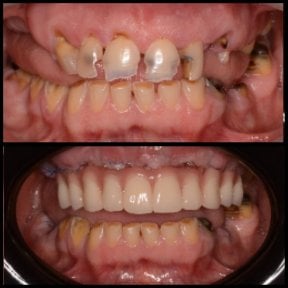
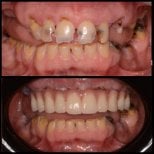
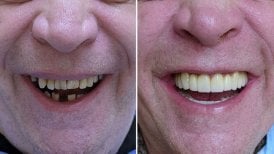
Before and after dental implant results at HALDENT Dental Clinic, improved smile restoration
Before and after dental implant results at HALDENT Dental Clinic, improved smile aesthetics
Before and after dental implant results at HALDENT Dental Clinic – full smile restoration
Before and after dental implant results at HALDENT Dental Clinic, restored smile transformation
4.8
(5 recensioni)
18 anni di esperienza

Nobel Biocare implant — clinically proven success rate over 99%, designed to last for decades.

Dr. Hubert Trzepatowski, a certified Nobel Biocare All-on-4 trainer, performs the procedure at the Polish Association of Implantology-accredited HALDENT Dental Clinic. The package includes a Nobel Biocare implant, zirconium crown, and 3D CBCT scan for precise planning. It costs around $2,620 and the approach – open or closed healing – is chosen based on this scan. The clinic's on-site laboratory streamlines the process, and it maintains a 98% patient recommendation rate.

Memorial Bahçelievler Hospital

This package includes a full week of inpatient hospitalization for monitored recovery with companion allowance. Dr. Ufuk Ozkaya performs surgical bone graft placement and infected bone removal at the Memorial Bahçelievler Hospital. Priced at about $2,000, the all-inclusive fee covers a PCR test, anesthesia consultation, preoperative tests, and a follow-up consultation post-discharge. The clinic is JCI and ISO accredited – global benchmarks for safety and quality – and has a 4.7 patient rating.

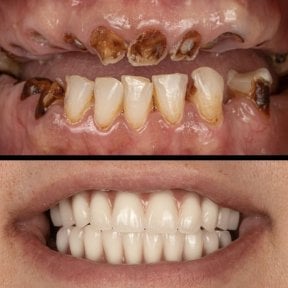
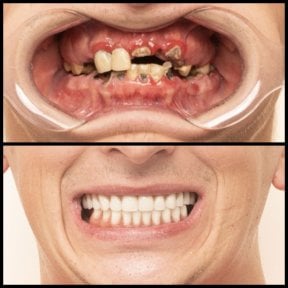
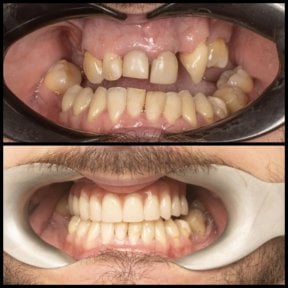
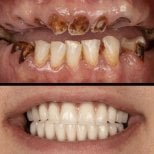
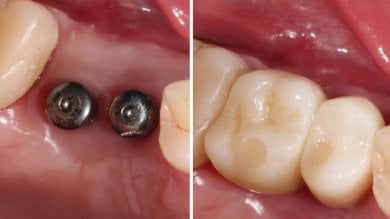
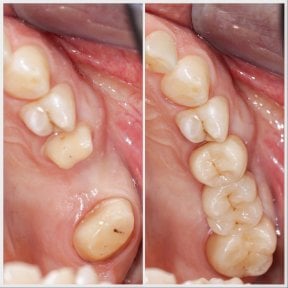
Before and after dental implant results at Smile Centrum – restored smile and improved teeth
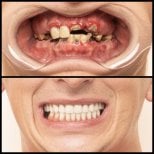
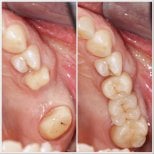
Before and after dental implant results at Smile Centrum – restored molars with natural look
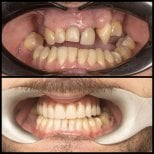
Before and after dental implant results at Smile Centrum – improved smile and restored teeth
Before and after dental implant results at Smile Centrum – restored front teeth appearance
4.3
(7 recensioni)
17 anni di esperienza

Dental implants from a top doctor

Dr. Vladyslav Ridchenko and his team use CBCT 3D imaging to plan personalized treatment, offering single-stage with an immediate crown or the traditional two-stage approach. This competitively priced package includes a Korean Neobiotech implant and ceramic crown for around $1,400 — well below the clinic's standard rate. Treatment occurs at the multilingual Smile Centrum in Prague, which has served 70,000+ patients. Their on-site laboratory crafts the final crown, with a 3–5 month healing period ensuring proper osseointegration.

Scopri le migliori cliniche di Bone Graft: 3 opzioni verificate e Prezzi

Le classifiche delle cliniche di Bookimed si basano su algoritmi di data science, offrendo un confronto affidabile, trasparente e oggettivo. Considerano la richiesta dei pazienti, i punteggi delle recensioni (positive e negative), la frequenza di aggiornamento di trattamenti e prezzi, la rapidità di risposta e le certificazioni delle cliniche.
Good Look Clinic
WestDent Clinic
Annuncio
Smile Terminal Dental Care
Annuncio
Dentfix Turkey Clinic
Anadolu Medical Center
SoftDentalCare Clinic
Hai visto 4 di 306 cliniche

Migliori cliniche per Bone Graft al mondo

  • Good Look Clinic, Turkey
  • WestDent Clinic, Turkey
  • Anadolu Medical Center, Turkey
  • Smile Terminal Dental Care, Hungary
  • SoftDentalCare Clinic, Mexico

Panoramica di Bone Graft

Conclusioni
Procedure correlate e Costi
Come funziona
Cosa aspettarsi
Vantaggi
Pagamento
pazienti raccomandano -
85%
Tempo dell'intervento - 3 ore
Soggiorno nel paese - 7 giorni
Riabilitazione - 4 giorni
Anestesia - Anestesia generale
Recensioni verificate dei pazienti - 21
Commissioni Bookimed - $0

Ottieni una valutazione medica di Bone Graft: consulta ora 182 medici esperti

Vedi tutti i medici
verificato

Susana Akdash

17 anni di esperienza

Dr. Susana Akdash specializes in advanced implantology and bone grafts, using high-quality dental treatments tailored for complex cases.

  • Trained extensively in implantology and prosthetics at Ege University
  • Completed a thesis on 'Implant Prosthesis and Aesthetics' focusing on dental aesthetics
  • Attended multiple seminars including a Bone Augmentation Course
  • Member of various dental congresses and symposiums
  • Expert in digital surgery solutions for precise implant placement
verificato

Imad Alboshe

10 anni di esperienza

Dr. Alboshe specializes in Hollywood smiles and secure implant procedures, combining precision with patient education for optimal results.

  • Trained at FUTURE University in Egypt and OKAN University in Turkey
  • Uses state-of-the-art technology for advanced dental care
  • Focuses on personalized treatment plans and patient comfort
  • Dedicated to educating patients about their procedures
verificato

Miller Vieira Paula

26 anni di esperienza

Over 25,000 dental procedures performed – Dr. Miller Vieira Paula combines artistry with advanced implantology at YeahSmile.

  • 20+ years of expertise in functional and aesthetic dentistry
  • Specializes in advanced bone grafting and implant techniques
  • American Dental Association and AACD member with international certifications
  • Trained in Digital Smile Design and high-performance porcelain techniques
verificato

Ertan Etemoglu

32 anni di esperienza

Over 25 years of specialized experience in bone grafts and dental implants at Tower Dental Clinic in Istanbul.

  • Specializes in oral surgery and implantology, with a focus on complex cases
  • Member of the American Dental Association
  • Skilled in sinus lift and zygomatic implant techniques
  • Multilingual team available for international patients

Storie in video dei pazienti Bookimed

Viktoriya
If you're in the dental implant boat, don't let confusion steer you off course. Bookimed might just be your compass to a perfect smile.
Procedura: Dental Implant
Clinica: YEG Clinic
zahide agar
1 set 2025
Recensione verificata.
I would recommend her any day
Iain
22 gen 2026
Recensione verificata.
I am extremely pleased with the final results and have had so many great reactions and comments about my new teeth, especially how natural and real they look
Ilona
8 feb 2026
Recensione verificata.
I'm absolutely thrilled with the results!
Yuriy
7 set 2025
Recensione verificata.
The coordinator Valeria was very helpful and advised with everything I asked her about
Valiantsina Panasiuk
19 gen 2026
Recensione verificata.
A special thank you to Dr Imad! He is a true professional! He is very attentive and professional in his work!
Kimberlie Jackson
22 ott 2023
Recensione verificata.
It was an experience my husband and I will never forget!!
Anatol Kaptsionak
3 gen 2026
Recensione verificata.
Our overall impression of the clinic is very positive
Nadіya
2 gen 2026
Recensione verificata.
I am very satisfied with the treatment and service I received
Fiona Dale
19 mag 2025
Recensione verificata.
I really can’t thank you enough, you have changed my life
Zhanna Firenze
25 apr 2025
Recensione verificata.
Thank you to the whole Westdent team for your skill, care and sincere attitude to patients!
Elena Romaniutina
26 mar 2025
Recensione verificata.
I am very satisfied with the results of the treatment and implants, and I would recommend this clinic to anyone looking for quality dental services
Pablo
9 dic 2025
Recensione verificata.
the doctor is the best professional
Thekla Arndt gräbener
13 feb 2025
Recensione verificata.
I am convinced that I will have a radiant smile
Iain
19 set 2025
Recensione verificata.
I am so happy that I went ahead with my treatment
Natal'ya
24 ott 2024
Recensione verificata.
I am so happy with my dental treatment at the GK Dental Clinic!

Condividi contenuto

Aggiornato: 02/08/2026
Scritto da
Anna Leonova
Anna Leonova
Responsabile del Team Content Marketing
Copywriter medico certificato con oltre 10 anni di esperienza, ha sviluppato i contenuti affidabili di Bookimed, con il supporto di un Master in filologia e interviste con esperti medici da tutto il mondo.
Revisione da parte di Consulente medico Bookimed
Fahad Mawlood
Editor medico e Data Scientist
Medico generico. Vincitore di 4 premi scientifici. Ha lavorato in Asia Occidentale. Ex capo del team medico per i pazienti di lingua araba. Ora responsabile dell'elaborazione dei dati e dell'accuratezza dei contenuti medici.
Fahad Mawlood Linkedin
Questa pagina può includere informazioni relative a varie condizioni mediche, trattamenti e servizi sanitari disponibili in diversi paesi. Si prega di notare che il contenuto è fornito solo a scopo informativo e non deve essere interpretato come consiglio o indicazione medica. Si prega di consultare il proprio medico o un professionista sanitario qualificato prima di iniziare o modificare un trattamento medico.

Tutto ciò che devi sapere su Bone Graft

Bone Graft Procedure Overview

The bone loss in the area of a tooth defect is one of the most common relative contraindications to dental implants. Nevertheless, most patients, 70-90% in the maxilla and up to 50% in the mandible need bone augmentation before dental implants installation. 

An artificial bone graft material placement is required for those patients who have been missing teeth for more than two months. Unfortunately, most patients have much longer terms, up to 10 years or more. In such cases, various bone grafting procedures come to the rescue.

What Is a Bone Graft for a Dental Implant?

Bone grafting (osteoplasty, sinus lift, bone augmentation) is a surgical intervention during which the surgeon finishes building the tissue volume necessary for dental implant. Top maxillofacial surgeons in the global dental implant clinics perform the procedure following low-traumatic modern protocols and international quality standards. 

According to the diagnosis results, a dental professional performs bone grafting simultaneously with implantation or carries it out as a separate operation.

Why is bone growth required?

Often in our surgical practice, there are conditions when the bone is not ready to accept the dental implants. If there is a vertical or horizontal defect, bone grafting is necessary.

Such problems arise for such reasons as: 

  1. traumatic extraction of natural teeth
  2. individual anatomical features on the upper or lower jaw. 

If the tooth is removed long ago, the body is physiologically rebuilt, and a narrow bone ridge can build. To bypass these obstacles during dental implant surgery, dentists do gum tissue augmentation.

How Do They Do Bone Grafts for Dental Implants?

Because of some reasons, over time, after tooth extraction, bone volume decreases. Sometimes, when implanting a tooth, it is necessary to restore tissue. Bone grafting comes to the rescue.

Most often, patients who have lost a tooth more than a year ago face the problem of lack of natural bone. Thus, the body reduces the extra bone volume because it is no longer needed. That is why dentists recommend installing an implant in place of the extracted tooth as soon as possible.

Sometimes bone loss is a physiological feature. In this case, there is also a need for surgery. Bone grafting can be performed on both the upper and lower jaw.

How does it work?

The purpose of the operation is to create a foundation that will serve as the basis for the engraftment of the future implant. The complexity of the process explains the relatively high cost of bone grafting during dental implants placement.

Doctors perform dental bone grafts in different ways: 

  1. transplant the patient's own gum tissue of the upper jaw and other donor areas 
  2. tissues of animal origin
  3. synthetic fabrics. 

The dentist individually determines the type of bone graft procedure for each patient.

After the bone graft is inserted, your body may mend itself. A dental bone graft is like a scaffold on which new bone may grow.

Your dentist may mix a bone transplant with PRP (platelet-rich plasma). Your own blood is utilized to aid healing and tissue repair.

Types of bone graft surgery

Bone augmentation surgeries in dentistry include socket preservation, ridge augmentation, sinus lift, and periodontal bone graft.

  • Socket preservation. This graft is inserted in the socket following a tooth extraction. It replaces the lost tooth's socket and prevents collapse.
  • Ridge augmentation. If you lack teeth, your jawbone may be thinner. This bone graft widens and thickens the jawbone to support implants or other restorations.
  • Sinus lift. Just above your top back teeth are the maxillary sinuses. Sinuses may invade missing upper back tooth roots if they're lacking. Implants would pierce the sinus membrane in this situation. A sinus lift may fix this condition. This treatment elevates the sinus. A sinus bone transplant provides a stable foundation for dental implants.
  • Periodontal bone graft. Gum disease may damage tooth-supporting bones and cause loosening teeth. A bone transplant is used to minimize tooth movement and enhance support.

Preparation 

Osteoplasty is performed after careful preparation. The patient must undergo oral hygiene a week before the operation and a general examination — blood tests, consultation with a cardiologist, a therapist, and, if necessary, an endocrinologist. The process of the bone graft itself depends on the chosen technique and the materials used. Manipulations are carried out under general or local anesthesia.

Do dental bone grafts tend to fail?

Incredibly high success rates may be seen for dental bone grafts. Failure is possible with any surgery, but it's more likely in those who smoke or have specific health issues. Dental bone graft failure indicators include:

  • Post-week pain or swelling.
  • Bone graft pus or discharge.
  • Receding gum (when the gums pull away from the teeth).
  • Jawbone volume unchanged.

How Long After Bone Graft Can Implant Be Placed?

On average, the dental implant is possible about 4 months after bone graft. In the case of complex intervention, the period can increase to 6-9 months. Sometimes parallel grafting and installation are possible. The most suitable option for a particular patient during diagnostics is selected. 

Can dental implant and bone graft be done at the same time?

In many countries, dentists resort to parallel bone graft and dental implant, significantly saving treatment money and time. This tendency is prevalent in clinics in countries such as Turkey, Ukraine, and Mexico, where dentistry is developing at a frantic pace, and there is a great demand for such procedures among international patients. 

Moreover, doctors in these countries provide patients with dental implant packages — such offers usually include both bone graft and dental implant. Also, tooth packages contain all materials and medicines needed for successful dental implants placement. At the same time, these hot deals are cheaper than the separate procedures.

What happens if you don't get an implant after a bone graft?

The bone will repair, but it will heal in its way, which means that the walls that used to house that tooth may collapse, causing you to lose the height and width of the bone. The more bone you lose, the less likely you will be a suitable candidate for an implant.

How Painful Is a Bone Graft for Dental Implants?

The patient does not feel any pain immediately after the bone grafts because the anaesthesiologist injects painkillers and sedatives before and during the procedure. Anxiety may appear by the end of the day or the next day after the intervention. 

To relieve pain, the dentists recommend taking painkillers. Painful feelings should be gone entirely within the first week after the surgery.

Are you put to sleep for a dental bone graft?

Patients are often not put to sleep for bone graft procedures because it may be done simply with a local anaesthetic. Sedation is available in almost all dental implant clinics. Specialists can offer nitrous oxide, oral sedation, and intravenous (IV) sedation. 

It's also possible that general anaesthesia may be needed if your scenario is very complex. Ask your dentist for advice on which sedation option is most suited to your case.

How Long Does a Dental Bone Graft Take to Heal?

A healing process after the dental bone graft procedure may take three to nine months. This time is enough to heal completely , and it's not uncommon for this procedure to take longer. Several variables affect recoveries, such as type of graft, location of placement, and your body's ability to mend. Ask your dentists about the healing period in your particular situation.

How Long Does the Recovery Period Last After Bone Grafting?

The duration of the rehabilitation period is determined by the volume of postoperative consequences, which depend on the operation's scale and the body's reaction.

Typically, recovery after bone grafting takes no more than two days. During this time, pain and swelling go away. By the third day, the wound stops bothering, but the stitches are removed only on the 10-14th day after the procedure. Missing bone is formed within a few months. 

Patients need to visit a doctor for follow-up examinations. The computed tomogram determines the degree of maturity of the bone tissue. Only after this step, a dentist can determine the optimal implantation period.

Accelerated rehabilitation

For patients who want to quickly go through the period of operational inconvenience and get their dental implants as soon as possible, the leading dental implant clinics provide accelerated rehabilitation programs. Such recovery plans include different therapeutic procedures selected individually for each patient to speed up the rehab time and get back to the patient's everyday lifestyle in the shortest term. The accelerated rehabilitation programs may contain:

  • Injections of lymphatic drainage drugs (biostimulants, peptides, a complex of microelements, and vitamins) to improve blood and lymph circulation have anti-inflammatory properties. Minimize swelling and bruising, and accelerate wound healing.
  • PRP plasma therapy — the blood plasma is rich in platelets, which use the body's reserve forces. As a result, the work of the immune system is enhanced, and reformation processes proceed faster. Puffiness and bruising disappear, and soft tissues heal more quickly.
  • Microcurrent therapy — exposure to the skin of the face with weak currents activates the work of cells. Recovery processes are accelerated, and blood circulation improves. Puffiness and pain syndrome disappear, and spasms of the muscles of the face and neck decrease.

General recommendations after bone grafting

Following your doctor's recommendations during the rehabilitation period will prevent possible complications. Here are the most common of them:

  1. Refraining from chewing on the operated side in the first days after the bone graft is better.
  2. Eat only room-temperature chopped food during the first 2-3 days.
  3. Do not smoke or drink alcohol for two weeks after the surgery.
  4. Cough carefully and with an open mouth so as not to increase pressure in the oral cavity.
  5. It is better to sleep with your head up.
  6. Physical activity and diving are prohibited for several weeks.
  7. It is not recommended to stay in the sun for a long time. It would be best if you stopped visiting solariums.
  8. It is forbidden to visit the sauna or take a bath.
  9. It would help if you refrained from flying in the first few weeks after bone grafting.
  10. Observe physical and emotional rest. The doctor will monitor your state during your scheduled follow-ups.

Takeaways

If your jawbone begins to deteriorate, it may lead to a domino effect of problems, including tooth loss and mobility issues. You may be eligible for dental implants and other tooth operations if you have bone grafts in your jawbone. Bone graft surgery may be an option if you have jawbone degeneration and want to regain your oral health and function and your general well-being.

Richiedi una consulenza gratuita

Seleziona il modo migliore per essere contattato